
Causes of Thumb Pain When Gripping
In short
Are you experiencing thumb pain when gripping, but you're not sure why? Keep reading. The Hand and Wrist Institute has the answers you seek.
Call (817) 382-6789 to have this looked at, or book online with Dr. Knight.
Thanks to opposable thumbs, humans can grip objects and perform fine motor skills. But what happens when you experience pain while gripping these objects? How do you know what the culprit is and how to treat the issue? Use this guide to learn more about the diagnosis of certain thumb ailments and what you can do to minimize the pain.
Thumb Sprain
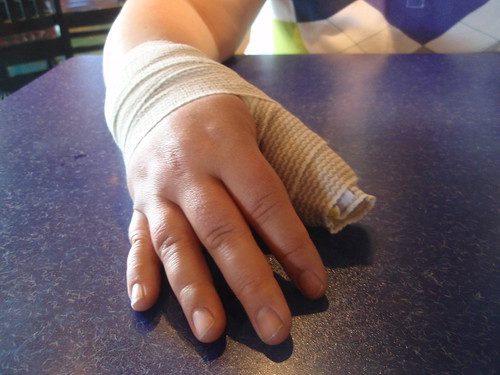
Image via Flickr by Joelk75
A thumb sprain occurs when the ligaments of the thumb are stretched beyond their limits. They might also become torn due to the hyperextension. The ligament is a fibrous band that connects from one bone to the other. A sprain happens when a strong force bends the thumb backward and away from the palm. The American Academy of Orthopaedic Surgeons states that most thumb sprains happen when someone falls onto an outstretched hand.
Most thumb sprains involve the ulnar collateral ligament, which sits on the inside of the knuckle’s joint. If you experience a sprained thumb, you might notice swelling, pain, or bruising near that area. A tear to this ligament is painful and makes the thumb feel unstable. To diagnose the sprain, a doctor will move your thumb around in several directions to determine how it’s affected by the damaged ligament. You might also have an X-ray done to see how bad the damage is to your bones and muscles.
Treatment for this type of injury, in which the ligament hasn’t torn, might heal with the assistance of the RICE treatment plan:
- RestProvide support for the thumb, and let it rest for as long as possible.
- IcePlace a wrapped ice pack in a cloth, and place it on the sprained thumb for about 10 minutes every hour during the first day.
- CompressWear an elastic bandage around the thumb to reduce swelling.
- ElevateTry to keep your sprained thumb raised above your heart to reduce pain and swelling.
If you’ve experienced a partial tear, you might need to wear a splint or cast to prevent the thumb from moving. The splint or cast needs to remain as long as it takes for the ligament to heal, which typically occurs around four weeks. For more severe sprains, surgery might be necessary to make the joint more stable.
Carpal Tunnel Syndrome
The carpal tunnel is a narrow tube of ligaments and bones that are located inside the wrist. The median nerve runs through the carpal tunnel and into the palm, and it gives sensation to several parts of the hand including all the fingers. Carpal tunnel syndrome occurs when the wrist experiences inflammation due to compression on the median nerve. It causes a tingling or burning sensation in typically the first three fingers and thumb, as well as decreased gripping strength.
A doctor typically conducts one of the following tests to determine if you have carpal tunnel syndrome:
- ElectromyographyThis test measures electrical discharges produced in muscles and can identify damage to muscles controlled by the median nerve.
- History of symptomsThe doctor will ask when you typically experience pain and determine if there’s a pattern.
- X-rayThis can exclude other causes of wrist pain, such as arthritis or fracture.
To help you deal with carpal tunnel syndrome, there are several treatment options available. Try to rest the affected hand as often as possible, and consider wearing a splint at night. You could also apply cool packs to reduce any swelling or discomfort. For more severe cases, surgery might be required. During surgery, the affected ligament is severed to reduce pain on the median nerve. However, you might experience continued numbness or weakness in the hand.
Fractured or Broken Thumb
In certain instances when you’re having problems gripping after a thumb injury, you might have a broken or fractured bone in your thumb. You might experience intense pain near the site of the damaged bone that radiates up to the wrist and forearm. Depending on the extent of the injury, your thumb might become unstable and easily move from side to side. To determine if you have a fracture, an X-ray is taken of the thumb area.
If the bone fragments in the thumb stay close to the break, you might only need a temporary cast placed on the site to hold those fragments in place. Expect to wear the cast between four to six weeks. However, if the fragments are located away from the break, you might need surgery to realign these pieces. The surgeon uses wires, screws, or pins to hold these fragments in place so they can heal properly. After the surgery, you will likely wear the cast for two to six weeks so the thumb remains immobilized.
Hand Osteoarthritis
Hand osteoarthritis (OA) occurs commonly in the thumb joint nearest to the palm, which is the carpometacarpal (CMC) or basal joint. OA causes inflammation in the joints and the eventual breakdown and gradual loss of joint cartilage. The cartilage cushions the ends of the bones located in the joints, allowing them to move easily and smoothly. Once the cartilage wears down, you’ll experience pain and difficulty with movement in the thumb. To determine if you have OA, the doctor will look at your hands and inquire about your family history and symptoms. You might also have an X-ray done.
While no treatment option can reverse any damage of OA, you can take some steps to help alleviate the pain and reduce symptoms. Certain types of medication such as acetaminophen and nonsteroidal anti-inflammatory drugs can reduce the pain. You could also try intra-articular cortisone injections in the joint to manage swelling and inflammation. Surgery might be necessary if the OA severely affects the base of your thumb.
Contact the Hand and Wrist Institute Today!
Although it doesn’t present a significant health risk, thumb pain when gripping objects can be extremely frustrating. To learn more about how to fix your thumb pain, reach out to the experts at the Hand and Wrist Institute. Under the direction of Dr. John T. Knight, who has over 25 years of experience, the medical practice is a facility dedicated to the care, diagnosis, and treatment of the hand and wrist. Contact us today, and let us help you treat your thumb so you can live pain-free.