
Trigger Finger Surgery & Treatment in Dallas Texas
Call (817) 382-6789 to have this looked at, or book online with Dr. Knight.
What is Trigger Finger?
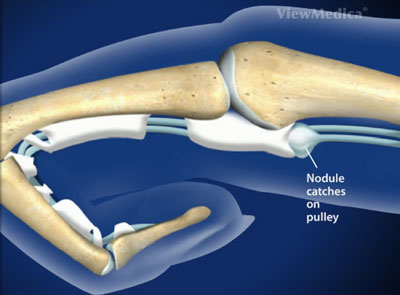
Tendons attach the bones in the hand to muscles in the forearm, allowing motion. The flexor tendons are located on the palmar surface of the hand. As the fingers bend into a fist these tendons glide thru tunnels called tendon sheaths that act to keep the tendons in proper position against the bones. Inflammation can cause the flexor tendon to thicken forming nodules which make it difficult to pass thru the sheath. The tendon sheath may also thicken, narrowing the passageway. Trigger Finger, or Flexor Tenosynovitis, occurs when the flexor tendon gets stuck in a bent position as the digit is being straightened. The digit may then “pop” straight with effort. This can happen in any of the four fingers or the thumb.
What causes Trigger Finger?
While the exact cause is unknown, several factors and activities have been associated with an increased likelihood of developing Trigger Finger. Some risk factors include female gender, middle age, and diabetes. Overuse or repetitive motion injuries, and inflammatory diseases, such as Rheumatoid Arthritis and gout, can also lead to this condition. Anything that produces prolonged inflammation of the flexor tendon, the tendon sheath, or both can result in Trigger Finger.

What are the symptoms of Trigger Finger?
The most prominent symptom is the motion of the finger as it is bent or straightened. The digit may “stick” as it is being bent and then “snap” closed. This can also happen as the finger is being extended. There may be pain or swelling of the finger and sometimes a lump can be felt on the palmar surface near a joint. The stiffness may be worse in the mornings or after periods of inactivity. In severe cases the digit may need manual assistance to fully flex or extend. Occasionally the digit becomes “locked” in either the bent or straight position.
How is Trigger Finger diagnosed?
Diagnosis is based on a complete medical history, review of symptoms, and physical examination. In general, no other testing is required.
How is Trigger Finger treated?
Non surgical
Mild or moderate cases of Trigger Finger usually respond well to conservative treatment. Resting the digit may be all that is needed. The finger may be immobilized in a neutral position with the aid of a splint. NSAIDs (non-steroidal anti-inflammatory drugs) like Ibuprofen may prove useful to ease pain. In moderate cases a corticosteroid injection may be administered to reduce inflammation.
Surgical:
In severe cases of Trigger Finger or those that do not respond to conservative treatment, surgery may be required. Trigger Finger Release Surgery is a quick outpatient procedure that releases the tight tendon sheath. A small incision is made in the palm, the sheath is opened in the palm and the wound is sutured closed. A Band-Aid type dressing is left in place for about 10 days. The sutures are then removed, and recovery usually takes about six weeks. During the recovery period there may be some mild tenderness at the incision site and activity is as tolerated. Hand therapy helps to strengthen, increase flexibility and reduce stiffness.
How can Dr. Knight help you with trigger finger?
If you think you have symptoms of trigger finger and are located in the Dallas, Texas area, a visit to a hand specialist is recommended. If you choose Dr. Knight, we have offices in Southlake and Plano. Dr. Knight will examine your hand, make a diagnosis and start with conservative measures, with surgery as a last resort. Dr. Knight treats Trigger Finger regularly.
Dr. John Knight is a hand and wrist surgeon in the Dallas, Texas area. Dr. Knight welcomes you to visit our Southlake, Texas or Plano, Texas location for a consultation. Dr. Knight treats carpal tunnel syndrome and removes ganglion cysts. On behalf of the entire clinic, we look forward to meeting you.
Trigger Finger Fact Sheet
| What causes Trigger Finger? | The exact causes of Trigger finger are not understood, but factors that contribute to the condition are: overuse, repetitive motion, female gender, and diabetes |
| Self Treatment for Trigger Finger | Rest, Splint, Ibuprofren, and NSAIDs are all effective methods of treating Trigger Finger at home. |
| Medications for Trigger Finger | Some medications that can help allay the symptoms of Trigger Finger include Ibuprofen, NSAIDs, and steroid Injection |
| Does Diabetes Cause Trigger Finger? | Diabetes can indeed be a factor in causing trigger finger. We do not understand the exact relationship between the two conditions, but studies support the conclusion. |
| Can I do exercises to help treat or avoid getting Trigger Finger? | Exercising the tendons of the fingers can help to avoid the development of Trigger Finger, or can help lessen the symptoms. Particular exercises include finger lifts of the affected digit, resistance exercises against a rubber band or the thumb if possible, as well as squeesing a stress ball (or tennis ball if you don't have a stress ball). |
| What complications can happen because of treatment for Trigger Finger? | Conservative treatment is unlikely to have complications, but surgery, particular an open release of the tendon sheath, can have some complications, namely a persistance of the pain and swelling of the joint. |
| Can Surgery Heal Trigger Finger? | Yes, Surgery is a last resort if conservative treatment proves ineffective. |
Frequently asked Questions:
What, exactly, causes Trigger Finger?
Trigger finger is one of those conditions that is not very clearly understood by the medical community. While we do know that there are certain risk factors associated with developing a trigger finger, the precise mechanisms that lead to the condition itself remain a mystery. Women are more likely to develop the condition, and it is theorized that this is a result of the smaller size of their hands, on average. Diabetes and rheumatoid arthritis are other risk factors for developing Trigger Finger, but, again, the precise relationship between these conditions and trigger finger is little understood.
Will Trigger Finger go away without me seeing a doctor?
In less serious cases, activities such as exercise and massage can help to reduce the inflammation associated with Trigger Finger, and anti-inflammatory drugs are also effective in stopping the progression of the condition. Even after symptoms develop, it is possible that the condition will spontaneously reverse itself over time, but this is rare. As the condition progresses, it will become necessary for you to see a doctor, and it is always better to see a doctor sooner than later in the course of an illness or injury, to avoid any complications bought on by being untreated.
Can Carpal Tunnel Syndrome lead to Trigger Finger?
Carpal Tunnel Syndrome and Trigger Finger are two conditions that Dr. Knight treats often, and it is not uncommon for them to occur in the same person, even on the same hand, but the mechanisms that lead to these conditions are generally not related with one another in regards to the development of symptoms. Both are conditions caused by overuse, though, so it is entirely possible that they can be caused by the same activities or work-related stressors.
Can Trigger Finger last forever?
While Trigger Finger is often known to reverse itself, in more serious cases the deformity can set in and become permanent, which can have very serious consequences for your manual dexterity, and can make even the simplest activities of daily living difficult.
What is the recovery time after Trigger Finger surgery?
Trigger Finger surgery, or Release, as it is known, is a relatively simple procedure, and although full recovery can take up to six weeks, once the dressing is removed after about ten days, you should expect to be able to start using your hand, as long as you are careful, because a return trip to your doctor to fix a problem during recovery is never a fun appointment.
Videos
Animated Videos

Our medical animations open in the practice's own animation player, in a new tab. They are not loaded into this page.
Surgical Videos
Read the transcript
These are Dr. Knight’s own words from the video. We corrected the anatomy and drug names the automatic captions got wrong and added the punctuation. Nothing he said was changed, added or taken out.
We're going to make an incision through the crease at the base of the thumb. I'm going to spread the tissue, opening the fat, the retractors to pull the nerves and arteries to the side of the wound. And then carefully I'm going to lift up the first pulley, or it's called the A1 pulley or annular pulley, exposing the tendon, showing the tendon right here.
And then I'm going to snip the pulley lengthwise to release the constricted band. It's impeding the tendon from moving fully. Now I've completed the division of the pulley. I'm going to gently tug on the tendon, the flexor tendon to the thumb, and I'm going to pull this out of the thumb. It allows me to move the thumb and make sure there's no further snapping of the thumb. And it will also allow me to inspect the lower surface or the flexor pulley sheath that you're seeing there deep to the wound.
Read the transcript
These are Dr. Knight’s own words from the video. We corrected the anatomy and drug names the automatic captions got wrong and added the punctuation. Nothing he said was changed, added or taken out.
Sesamoid impingement. This involved a patient with bilateral snapping little fingers. This shows preoperatively the snapping of the fifth MCP joint. On cine radiography, you can see the sesamoid catching on the volar aspect of the fifth metacarpal head, going from flexion into extension.
Intraoperatively, just before surgery, again demonstrating the catching. Again, this was bilateral. Sesamoidectomy underway. It shows the flexor tendons in the 12 o'clock position, working beneath these, removing the sesamoid overlying the fifth metacarpal head. See the chondromalacia on the inferior surface of the sesamoid. See the metacarpophalangeal joint beneath.
Releasing all soft tissue attachments to the sesamoid while protecting the neurovascular structures just ulnar to this. Now you can see the chondromalacia. Now comparing both sides, both hands, severe chondromalacia of the articular surface of the sesamoid bilaterally.
Wound has been sutured, patient is awakened and has to flex and extend the digit with marked improvement in the preoperative snapping. Post clinical motion, again full range of motion, no further discomfort, no significant snapping.
Note: The following videos contain graphic images.
A transcript is not available on this site.