What is Dupuytren’s contracture and how is it treated?
On the channel as “Dupuytren's Surgery”
In this video Dr. Knight explains Dupuytren’s disease, how the fascia in the palm thickens into cords, and when a bent finger becomes a reason for surgery. He covers the injection options and the surgical excision.
This is a transcript of a recorded talk from 2014. Any figures mentioned are from the recording and are not statements about current results or the practice.
Read the transcript 884 words
The transcript below is what Dr. Knight says in the video. We corrected the anatomy, drug and device names the automatic captions got wrong and added the punctuation and paragraph breaks. No words were changed, added or taken out. The uncorrected machine transcript is kept on file.
Transcript
Let's talk about Dupuytren's surgery. First, let's understand what Dupuytren's disease is. Let's take a look at the overall fascia. Fascia is a lining that's underneath the skin throughout the body, and in the palm it extends from the mid palm all the way out to the fingertips. What this does is just a thickened layer that kind of protects the tendons, nerves and arteries of the hand. And it's in this area that Dupuytren's disease can cause this proliferation or thickening of the fascia.
As you can see here in the next image, you can see here these nodules start to form, or it starts to proliferate and becomes quite thick. As you can see in the next image, Dupuytren's actually starts out as just a painless nodule. Patients will come in and they feel this thickening. Usually there's some predisposition based on kind of hereditary factors in some individuals, usually of Scandinavian descent, and they come in and they get this, again, thickening. It doesn't hurt. Occasionally it does, but that usually is self-limiting and goes away.
But where it starts to become a problem is when it starts limiting the ability to extend the fingers. So initially painless nodules develop, but then you start getting these cords that form, and that again out into the fingers the fascia starts to thicken. And as it does, as you can see here on the top on the little finger, it starts to curl the fingers down. It's more common in the little and ring fingers.
Now let's take a look now at an actual patient that has this. Again this cord starts to develop throughout the mid palm all the way out past the PIP joint, and it can start to draw down both the knuckle or the MCP joint and the PIP joint. Rarely it's the last joint, but usually it's one of the two or both of those.
So let's take a look actually at the animated picture. This shows the contracture. And a contracture meaning that the finger's contracted, doesn't straighten out all the way in this case. So it's called a flexion contracture because it's stuck in a bent position. Again, they can still bend fully and make a full fist, but they can't straighten out. So let's take a look now at an actual patient that had a PIP flexion contracture. The MCP joint straightened out all the way, but there was almost a 90 degree bend at this area right here.
Now, so let's take a look now at the treatment for Dupuytren's disease. We're going to concentrate on the surgery aspect, but to mention, there are two other common treatments many surgeons may perform in the office. One is an enzyme injection that there's some indications for, and a percutaneous needle release. But today we're going to concentrate on what many surgeons still do today, and that's a surgical excision of this thickened fascia.
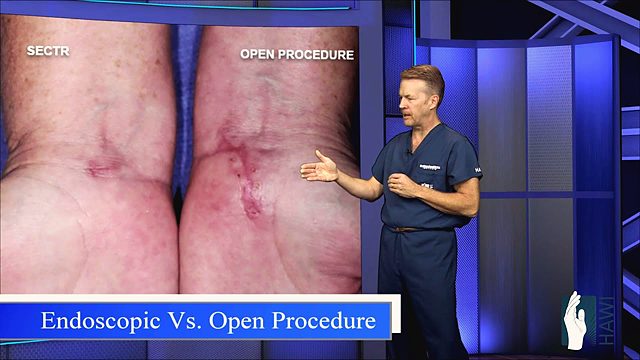
So let's take a look now at the incision. Most incisions on the palm side of the fingers, whether it's fixing a tendon that's been cut or in the case of Dupuytren's disease, we make a zigzag cut, because if you make a straight incision, that in itself as it heals can cause a flexion contracture of the digit. So as you can see here, let's take a look at an actual patient. You can see the zigzag incisions that have been made. There's sutures still in this patient that were used to straighten the fingers out. Next image we'll take a look. This is an actual healed, after all the stitches have come out, after a satisfactory healing period. You can see a nice scar and the contracture has been relieved as the fingers are straight.
Now, as we'll talk about now with the recovery, rehabilitation, first I want to mention the indications for how bad does the flexion contracture need to be before you do the surgery. Well, typically it's about a 30 degree bend of the knuckle, so about 30 degrees of bend from straight at the knuckle, or any degree of flexion contracture at the PIP joint. The PIP joint's harder to get straight, so really any flexion there is a reason for surgery.
After the surgery, usually within 3 days, you come back for a post-op wound check. The splint's removed that was put on at the time of surgery and we have a removable brace made. Now this is critical, to start bending right away because you don't want to lose the full grip that you have. But it's important to maintain through an extension splint, holding those fingers straight when you're sleeping and when you're not exercising, but frequently taking off the brace to do that.
The stitches come out 10 days later, you can start getting it wet at that point. All in all, it's about a 2 to three month total recovery period. There's about a 25% recurrence rate with this disease, but over the long haul, and in some patients they may have more than one digit involved. In some cases you'll take it out of the little finger and the ring finger pops up a few years later. For more on this and many other conditions, please check out our website.
Related page
This video is also listed in our informational videos and video gallery.