What is carpal tunnel syndrome?
On the channel as “Carpal Tunnel Syndrome - Everything You Need to Know”
In this video Dr. Knight explains what carpal tunnel syndrome is, why the median nerve gets squeezed inside the wrist, and which symptoms send people to a hand surgeon. He also walks through the tests used to confirm it.
This is a transcript of a recorded talk from 2018. Any figures mentioned are from the recording and are not statements about current results or the practice.
Read the transcript 769 words
The transcript below is what Dr. Knight says in the video. We corrected the anatomy, drug and device names the automatic captions got wrong and added the punctuation and paragraph breaks. No words were changed, added or taken out. The uncorrected machine transcript is kept on file.
Transcript
Hello, I'm Dr. John Knight. Today I want to talk to you about carpal tunnel syndrome.
First, what is carpal tunnel syndrome? Well, to get an appreciation for that, let's look at the anatomy of the carpal tunnel. The carpal tunnel is a channel that runs through the palm of the hand and wrist right here, and it's within this tight space that the median nerve, as you can see here, this yellow structure, and the white structure, the flexor tendons. And there's a tight ligament that is the roof, is the ceiling of that tunnel. And from repetitive use, swelling builds up on the tendons causing pressure of that median nerve.
So when this happens you get, you get symptoms in the area of the parts of the hand where the nerve supplies. So what is that? Well, it's numbness and tingling in the thumb, index, middle and half of the ring finger. You also, in severe cases, can get a loss of strength of the thenar muscles, which is the important muscle used for dexterity of opposing the thumb to the adjacent digits. One of the hallmark symptoms, though, is numbness and tingling and awakening the patient at night. And that's because we tend to ball up in a fetal position, and that puts more pressure in the carpal tunnel on that nerve.
So now for the causes of carpal tunnel syndrome, there are many. It could be inflammatory arthritic conditions such as rheumatoid arthritis that leads to swelling in the tunnel. It could be trauma that leads to swelling in the, in the tunnel. Or most commonly it's repetitive use of the hands. In this automated society we have younger and younger patients now coming in, from musicians to engineers, gamers, etc. But one of the most common is just frequent keyboard and mouse use, and what, from this repetitive use swelling builds up leading to symptoms of carpal tunnel syndrome.
So first, so then, how do we diagnose this? Well, first you go undergo a careful examination by a specialist, an orthopedic specialist or a hand surgeon, and they'll do a careful exam on you. The first they'll do is check feeling. Is there loss of sensation in that part of the hand? Is there any loss of strength, such as what may happen in severe cases? Then there's provocative tests that the specialist will do. One is, the most common is called a Tinel's sign. Basically that's tapping right over that nerve, and if it's irritable or compressed it will lead to a funny bone feeling in that area of the hand. And then there's a Phalen's wrist flexion test, where we have the patient bend the wrist for 60 seconds, and if that elicits similar symptoms, and that's a positive test. And then there's electrodiagnostic testing, as you can see here, called NCV EMG testing, and this is done usually by a neurologist or a physiatrist, and it helps us determine the severity of the underlying nerve compression, and it looks at other areas of compression also in the upper extremity.
So now that we have a diagnosis, let's move into treatment. The first, the hallmark of conservative treatment: remember I told you about numbness and tingling at night, bending the wrist puts more pressure on the nerve, so it would stand to reason you want to keep the wrist straight while you sleep. So wearing a simple over-the-counter wrist brace can give you a lot of relief at night, and really rest that wrist at the end of a long work day. And then in some cases, more severe cases, a cortisone shot may provide some relief. And then ergonomic assessment of the workstation, making sure your work environment is comfortable, taking frequent breaks from whatever that repetitive use is, is important.
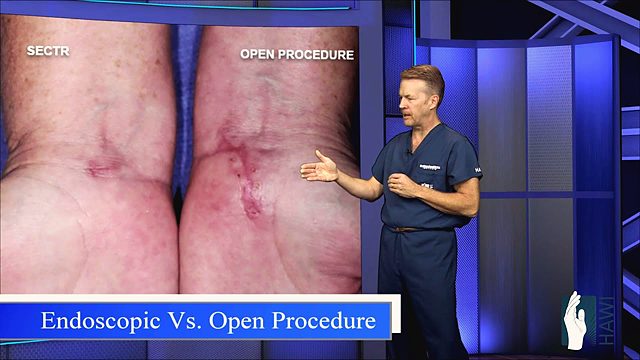
If all else fails, sometimes surgery is necessary. And I'm an advocate of the endoscopic carpal tunnel release. It's half the healing time of the open procedure, and you can see right here, through a little one centimeter incision we put the scope in, we're looking on a monitor, and we're cutting the ligament from the bottom up. And here you can see the ligament open up. And then after this procedure you'll see just a little band-aid as you wake up from the procedure. Again, a ten minute procedure. You're moving and using the hand right away. Very quick recovery and significant relief of the symptoms following this.
For more information on carpal tunnel syndrome or other conditions of the upper extremity, please visit our website, handandwristinstitute.com. Thank you.
Related page
This video is also listed in our informational videos and video gallery.