TMC Joint Replacement Surgery
Transcript:
Let’s talk about TMC joint replacement surgery. The TMC joint here at the base of the thumb is one of the most debilitating areas of the hand to get arthritis. It’s a very common area that we get arthritis. And this is precipitated by many daily activities that we do day-to-day such as forcefully grasping jars, lids, etc.. Removing these puts undue stress across that joint. Also simply opening a door with a key also puts stress across that joint.
But we need to look at the anatomy to appreciate what’s going on here. The TMC joint is made of the trapezium right here. It’s a saddle-shaped joint with the thumb metacarpal sitting on top of that. There’s so much movement in the thumb that occurs through this joint that allows our thumb to oppose to all the other fingers. And the thumb is 40% of the function of the hand.
So it’s in this tight saddle-shaped joint that over time from weakening of the ligaments from inflammation in the joint can lead to a narrowing down or wearing down of the cartilage with wear and tear degenerative arthritis or what we call osteoarthritis that occurs as we get older. Now this can occur with other conditions such as inflammatory arthritis (commonly rheumatoid arthritis). Or when there are fractures that occur into the joint at an earlier age that just don’t heal properly leading to what we call traumatic arthritis.
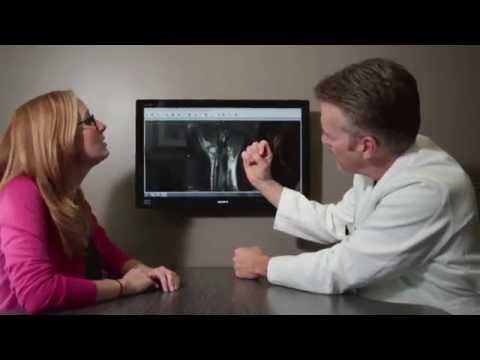
Now let’s look at an x-ray of this. The circle is around the trapezio metacarpal joint or TMC joint. And there’s very little space. You can see bone on bone changes occurring here as to the normal spaces as compared to the normal spaces throughout the rest of the joint.
Now the treatment for this initially, conservative treatment is the rule. This includes anti-inflammatory medication such as ibuprofen and wearing what we call a thumb spike brace, particularly at night to rest when you’re sleeping. A cortisone shot as a last resort may be beneficial.
But if conservative treatment fails, there’s a 40-minute outpatient surgical procedure that we do. This is considered when the condition is causing pain with just day-to-day activities, or even pain at rest, or pain awakening you at night. That’s when you look at doing this a little bit more extensive procedure.
We go in through two incisions at the thumb and on the metacarpal base of the index metacarpal. We’re going to first go in make cuts here and over on the base of the index metacarpal. Then we’re going to come in here with a little biter and we’re just going to remove that trapezium bone.
But we have to do something to keep the metacarpal from hitting the other bones. So we’re going to go in here and we’re going to drill a hole between these two bones. Then we’re going to take what we almost like a Kevlar type suture, like a bulletproof vest, it’s very strong suture. They’re using now for ACL reconstruction, shoulder reconstructions. And we’re going to put this, it has a little metal button at each end. And we’re going to tie that there. And it’s this button that acts like an internal brace to prevent this metacarpal from hitting the next bone.
Now some surgeons may elect to actually take an extra tendon that you have in the forearm, roll this up like a little olive ball, and place that into that space. With a new TightRope™ procedure though, you don’t necessarily have to do this. In fact, usually, I don’t do this and it’s still just as effective.
So let’s take a look at a post-op x-ray now. This shows the arrow here showing the open space after removing the trapezium. You can see the two buttons here that show that those are in good position. You can’t see the suture, but there is a suture that’s tethering between those two spots.
Now after this procedure, after this you’re placed in a brace. And after about the first week, you come back. We take the brace off, we remove the little bandages. The stitches or sutures dissolve. And then we place you in a removable brace. And that removable brace or total immobilization after surgery is for about one month. And then there’s about a two-month therapy protocol that happens at that point.
All in all, this is about 95% effective. It’s about a three-month total recovery. It’s 95% effective at reducing most of the discomfort. And it allows preservation of all the movement that you had in the thumb prior to surgery.
The only thing it doesn’t do is restore normal pinch strength. But it won’t hurt like it did to grasp before surgery. It just is never a normal joint as it was once the arthritis occurred and it never will be going forward. But it’s a highly effective surgery.
For more on this condition and many other conditions, please visit our website.
Schedule Appointment

Meet the Doctor


Where Does it Hurt?®
Not sure what service you need or what injury or syndrome you may have? Use our free, interactive tool to help you understand more about what you are experiencing. Start by clicking on the image below.
Real Patient Reviews


“I don’t often write reviews for Doctors offices..But this office is really exceptional in terms of service and my wrist is now great! Which is really the most important thing.”
Featured On